
NVIDIA Heads to the Cosmos: Elon, Jensen and the Orbital AI Renaissance
SpaceX wants to take AI computing into orbit. NVIDIA wants to supply the brains. Tesla is giving the flying-car conversation fresh thrust. If this is an AI renaissance, somebody has clearly ordered the ceiling removed.
For years, “the cloud” has meant somebody else's computers in a very earthly building. Now Elon Musk and Jensen Huang are helping push the conversation somewhere considerably higher. The next generation of AI infrastructure might not just need a postal address. It might need an orbital trajectory.
That is a wonderfully optimistic prospect. It is also a project, not a finished destination: the reported SpaceX–NVIDIA orbital computing milestones are future targets, not an announcement that a giant AI data center is already humming above our heads. The ambition, however, is real enough to make the technology world look up.
Elon on Jensen: “Old friends are the best friends”
Yahoo Finance's October 18 coverage reports Musk's October 15 comment: “Old friends are the best friends. Jensen rocks.” It also reports him describing work with NVIDIA's engineering team as a “pure joy.”
For two leaders associated with enormous technical ambitions, that is a refreshingly human endorsement. There is a difference between buying hardware from a supplier and enjoying the process of building something difficult together. The latter is where particularly interesting projects tend to begin.
Musk also described the SpaceX–NVIDIA “Star Mind” computer as “far better than almost anyone expects,” with volume production anticipated next year. Those are his expectations—not a performance result independently established by this article. Still, enthusiasm from the person trying to send the hardware into space is worth noting.
SpaceX supplies the lift. NVIDIA supplies the intelligence.
Light Reading reports plans for an orbital system built around NVIDIA's Vera Rubin NVL72, with a launch target in the fourth quarter of 2027 and “significant scale” envisioned in 2028. These dates describe the intended trajectory, not guaranteed delivery.
SpaceX's Starmind page describes planned AI satellites and deployments starting as soon as late 2027. It also makes clear that Starship's ability to move substantial mass into orbit matters to the plan. An orbital AI factory needs more than a clever chip: somebody has to get the chips, power systems, communications and supporting structure up there economically.
The pairing makes strategic sense. SpaceX brings launch and space-systems expertise. NVIDIA brings accelerated computing and a vast software ecosystem. If the engineering and economics come together, the result could be a new category of infrastructure—not merely an existing server room with a better view.
Jensen has spent years convincing the world that accelerated computing belongs in its data centers. Apparently, the next question is whether those data centers really need to remain on the planet.
Why orbit is interesting—and why the engineering still matters
AI's expansion creates demand for electricity, computing capacity and physical infrastructure. Orbit offers intriguing possibilities for solar power and an entirely different way of locating that infrastructure. It also opens the prospect of processing information closer to space-based instruments and networks.
But space does not make physics disappear. Vacuum does not automatically cool a GPU. Heat must be carried away from equipment and radiated into space. Solar availability depends on the orbit and design; radiation, debris, communications, maintenance and launch costs all matter.
That is not a reason to dismiss the idea. It is why the idea is exciting. Progress happens when talented teams turn an intimidating checklist into working machinery. The positive case is not “space makes everything free.” It is that the teams exploring this frontier have unusually relevant tools.
The flying Tesla gets a nod—but keep the seat belt on
The flying-car theme has fresh fuel, too. Tech Insider's discussion of Tesla's thrusters and aerospace redundancy considers the safety questions surrounding the idea. Its certification arguments should be read as that article's analysis, not an official aviation finding.
Independent Associated Press coverage of the Roadster demonstration describes the use of a ramp, suction and thrusters. Tesla's production target is 2028. A dramatic thruster-assisted demonstration is not the same thing as a certified flying car already available for everyday commuting—and it certainly does not make a Roadster a spacecraft.
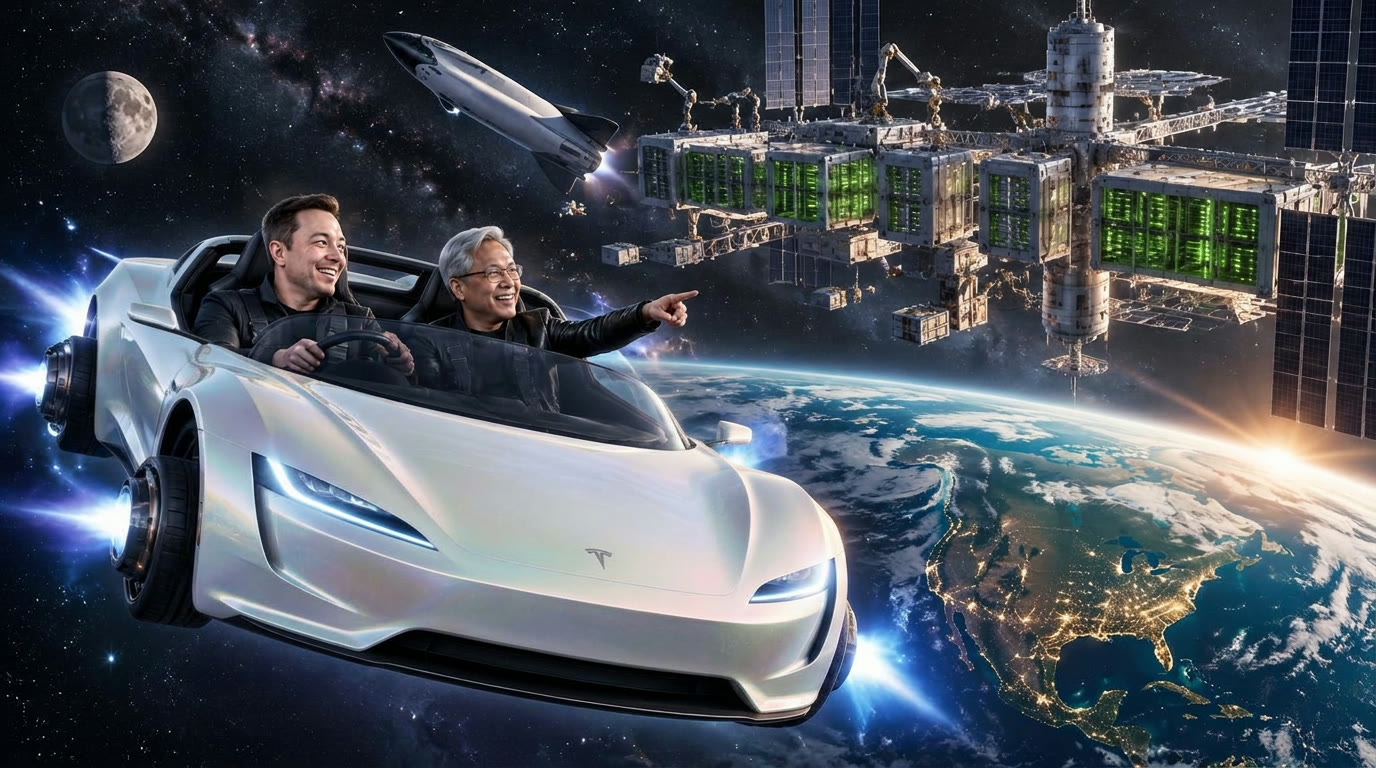
Our artwork takes the scenic route: Elon at the wheel, Jensen in the passenger seat pointing toward an orbital construction project. It is a humorous AI-generated concept, not a mission photograph. The joke is that even a cosmic road trip somehow becomes a data-center site visit when Jensen is riding along.
Flying cars and orbital computing are distinct engineering projects. But together they capture something uplifting about this moment: people are again discussing ideas that sound like tomorrow, rather than merely another slightly improved version of yesterday.
Are we living through an AI renaissance?
In our view, yes—with the important caveat that a renaissance is a period of possibility, not a promise that every invention succeeds. AI, robotics, simulation, advanced chips and reusable launch systems are developing alongside one another. Progress in one field can give another field a more powerful set of tools.
NVIDIA sits at a particularly interesting intersection. Its hardware and software already serve ambitious work on Earth. The orbital computing story extends that platform into another environment. Rather than treating AI as one product, the company has helped make it a foundation other industries can build upon.
There is a connection to our sovereign-AI discussion, too: computing capacity increasingly looks like strategic infrastructure. Countries want the ability to develop their own AI capabilities. Companies want the resources to build more useful systems. Space-based computing adds another possible frontier; it does not remove the need for governance, security or human judgment.
The old Renaissance had workshops, patrons and ambitious sketches. This one has GPU clusters, reusable rockets and two technology leaders who might reasonably ask whether the workshop can be placed in orbit.
The investor view: admire the mission, inspect the numbers
For readers following NVIDIA, the encouraging theme is the breadth of potential demand for accelerated computing. The orbital story is an additional long-term possibility, not proof of booked revenue or a guaranteed stock-price move.
For readers researching AI penny stocks or space-related small caps, keep the same discipline. A company does not become an NVIDIA or SpaceX partner simply because its press release contains “AI,” “satellite” and a rocket emoji. Look for actual contracts, financing, revenue and execution. High trading volume can mean selling as readily as buying.
NVIDIA seems to be heading to the cosmos
That is the upbeat takeaway: NVIDIA's story is no longer confined to faster graphics or even bigger terrestrial AI clusters. Its computing platform is part of a conversation about entirely new places to build.
Elon brings the appetite for ambitious transport. Jensen brings the engines of accelerated intelligence. Neither cancels the engineering risk. Together, though, they offer a compelling reminder that technological progress can still surprise us.
We seem to be living in an AI renaissance. NVIDIA is helping build the tools—and the next workshop may have Earth in the window.
We can't go back. AI is the way. Just make sure the navigation system knows which planet you parked on.
Sources & further reading
- Yahoo Finance: Elon Musk's comments on Jensen Huang — friendship, engineering collaboration and production expectations.
- Light Reading: SpaceX orbital data centers with NVIDIA — reported Vera Rubin system and 2027–2028 targets.
- SpaceX: Starmind — first-party description of the proposed orbital AI infrastructure.
- Tech Insider: Tesla thrusters and aerospace redundancy — commentary on the flying-car concept and safety questions.
- Associated Press: Tesla Roadster demonstration — independent reporting on the thruster-assisted display.
Opinion and commentary, not financial advice. Development targets can change, and enthusiasm for technology does not guarantee investment returns.