
NVIDIA and Sovereign AI: We Can't Go Back. Technology only advances forward
Linus Torvalds brings the engineering perspective. Jensen Huang brings the chips and Elon provides access to the Cosmos. Together, they point toward a future that is unlikely to come with a “return to machine code” button.
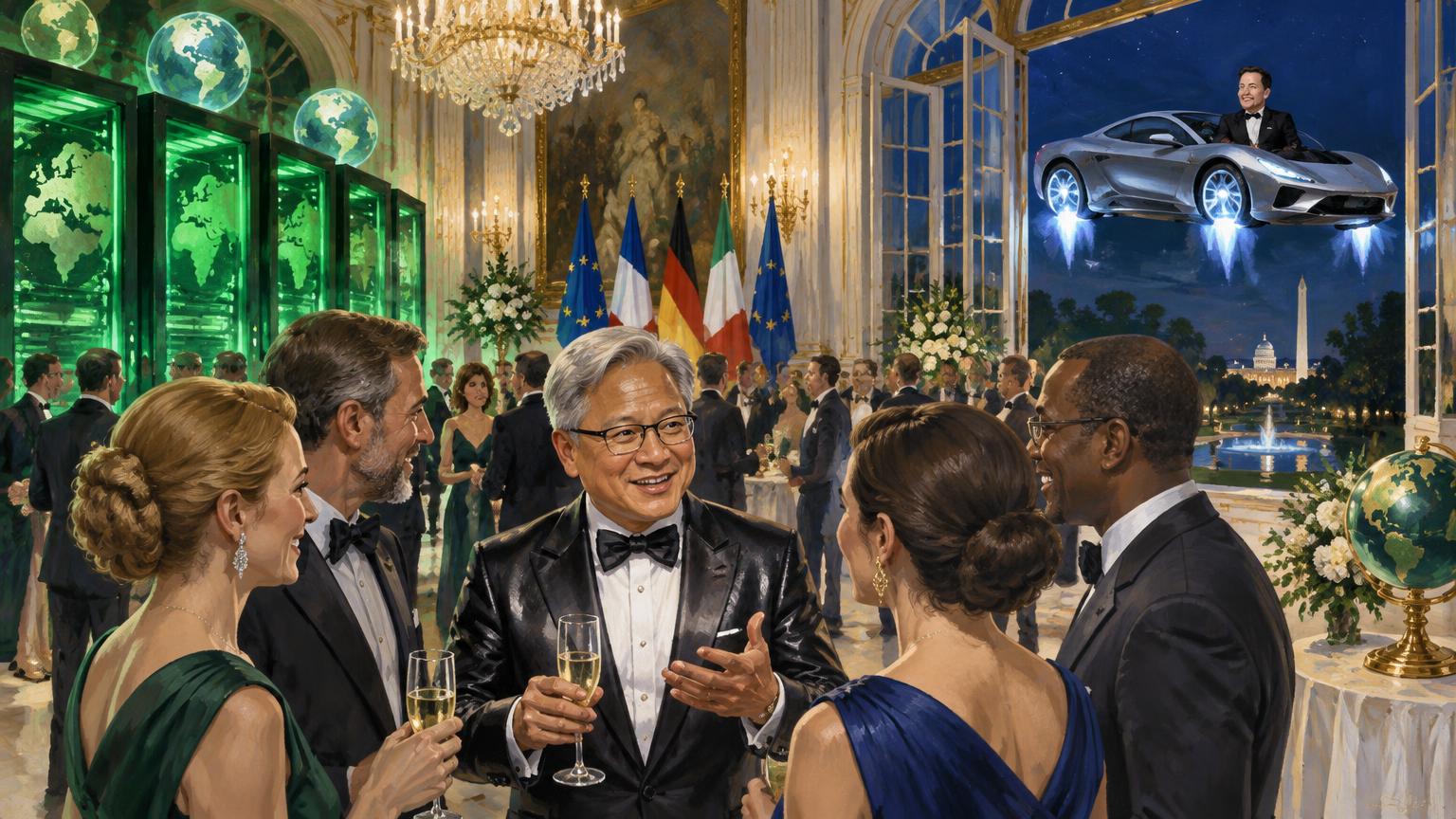
Every technological leap eventually produces the same conversation: “Do we really need this?” Someone probably asked it about compilers. Someone definitely asked it about the internet. Today, we are asking it about AI—often while a translation tool, recommendation engine or coding assistant is quietly making our day easier.
Our optimistic answer: we can improve it, argue about it and insist on using it responsibly. But pretending we can simply uninvent it is not much of a strategy. And few companies are better positioned for that reality than NVIDIA.
Linus Torvalds: progress, with the engineer still in charge
In ZDNET's account of Torvalds' love-hate relationship with AI, the Linux creator describes a familiar progression: writing raw machine-code numbers, then using assemblers and compilers, and now encountering AI-assisted development.
The encouraging part is not that he thinks programmers should stop thinking. Quite the opposite. He sees useful tools and changing workflows, while insisting that developers understand the code they maintain. He also flags the headache of low-quality, duplicate AI-generated reports. Even the future needs someone to take out the digital recycling.
“We can't go back” is our takeaway, not a verbatim Torvalds quote. His abstraction analogy makes a compelling point: moving up the toolchain does not erase the knowledge below it. It lets people tackle more ambitious problems. We did not abandon engineering when compilers arrived; we stopped making engineers do quite so much work by hand.
AI belongs in that conversation as a powerful assistant, not an infallible oracle. A good coding assistant is a tireless junior colleague. It still needs review—and occasionally someone to say, “Lovely confidence. Unfortunately, that function does not exist.”
NVIDIA is selling more than the engine
NVIDIA's advantage is not simply that its GPUs are useful. It is the combination of accelerated hardware, CUDA, libraries, networking and a broad developer ecosystem. An organization building AI wants the pieces to work together. NVIDIA offers a deeply established starting point.
That is why the company's influence extends beyond chatbot headlines. AI can assist with scientific research, industrial simulation, translation, software development and medical-image analysis. Human judgment remains essential, particularly in high-stakes settings. But the opportunity is enormous: less time on repetitive work, more time on decisions and discoveries that matter.
Dominance does not mean there are no rivals. AMD, custom accelerators and alternative software stacks are very real. Our positive thesis is narrower—and sturdier: NVIDIA has built an unusually strong position in a field whose usefulness extends far beyond one fashionable application.
Sovereign AI: nations want a steering wheel, not just a passenger seat
Sovereign AI is the idea that countries should have meaningful control over their AI capabilities: infrastructure, data, skills and models that reflect local languages, laws and priorities. It is not just a server with a national flag taped to the side.
A country's hospitals, universities, manufacturers and public institutions have different needs from a generic global chatbot. Local capability can help them develop tools suited to those needs, protect sensitive information and build expertise at home. Openness and international cooperation can still play a major role; sovereignty need not mean isolation.
This is a natural opportunity for NVIDIA. Its hardware and software can help countries build that capacity with local partners. Buying GPUs alone does not create sovereignty—countries also need talent, governance, energy and control over deployment—but NVIDIA can supply a crucial part of the foundation.
In our view, Huang's cleverest pitch is that AI is not merely something governments should regulate or import. It is something they should help their own people build. That turns a conversation about chips into a conversation about national capability.
Jensen's European tour: fluent in GPUs and prime-minister
CNBC's October 16 London report describes Huang's European tour and NVIDIA taking stakes in five UK startups. His pitch to those founders was characteristically memorable: “We're not your largest investor, but we are your best investor.” Fortune's European-tour coverage also reports a meeting with French President Emmanuel Macron.
That combination—entrepreneurs in one room, national leadership in another—captures Huang's gift. He can explain the technology, but he also knows how to explain why the person across the table should care. To a founder: build faster. To a government: develop domestic capability. To an industry: make your next leap possible.
NVIDIA's rolling GTC Berlin coverage points to the October 20–22 event, still ahead as this article is published. It is a useful place to follow the company's announcements—not independent proof that every ambitious plan will succeed.
Our read: Jensen is exceptionally effective at turning a technical roadmap into a national conversation. Other executives bring a slide deck. Jensen brings a slide deck, a platform ecosystem and the energy of someone who has already found your country's next industrial project.
The $25 million ballroom pledge
There is a real news item behind the ballroom. CNBC's donor coverage and NPR's investigation, citing Washington Post reporting, put NVIDIA's White House ballroom pledge at $25 million. CNBC reports that NVIDIA confirmed a multimillion-dollar donation and described the recipient as a nonpartisan trust. A reported pledge is not the same as evidence that the entire sum has already been paid.
Elon's real compliment is much simpler
The real-world exchange is warm enough on its own. Yahoo Finance's October 18 article reports Musk's October 15 comment: “Old friends are the best friends. Jensen rocks.”
It also reports praise for working with NVIDIA's engineers on a SpaceX–NVIDIA computing collaboration. Those are Musk's comments and expectations, not independent verification of future performance. Still, the simple compliment says plenty about the personal relationship behind the technical work.
The daily-life test—and the investor reality check
The strongest positive case for AI is not that every demo is spectacular. It is that useful capabilities keep finding their way into ordinary tasks: understanding another language, navigating a large document, exploring an idea, catching a coding mistake or helping a specialist analyze information faster.
Some tools will disappoint. Some businesses will overspend. Accuracy, privacy, energy use and human accountability still matter. Recognizing those limits is not anti-AI; it is how useful technology earns a lasting place in daily life.
For readers watching NVDA or researching AI penny stocks, distinguish a powerful industry trend from a good trade at any particular price. NVIDIA is not a penny stock, and smaller companies do not inherit its strengths merely by putting “AI” in a press release. Check actual revenue, financing and execution. Unusual volume alone can mean selling, not opportunity.
We can't go back. AI is the way!
Torvalds' pragmatism and Huang's optimism are more compatible than they first appear. One says: use better tools, but understand your work. The other shows how much infrastructure those better tools will need.
We are bullish on that direction of travel—not on the idea that every stock must rise or every prediction must come true. Nations want capability. Developers want leverage. People want help with real problems. NVIDIA is exceptionally well placed where those ambitions meet.
We can't go back. AI is the way! The sensible route is forward—with better tools, capable people and a little humor.
And if the future has a dress code, we suspect Jensen has already ordered it in leather.
Sources & further reading
- ZDNET: Linus Torvalds has a love-hate relationship with AI — programming tools, fundamentals and maintainer concerns.
- CNBC: Jensen Huang in London — European tour and UK startup investments.
- Fortune: NVIDIA's European spending spree — European context and Macron meeting.
- NVIDIA: GTC Berlin 2026 rolling coverage — company announcements; a first-party source.
- CNBC: NVIDIA and Cisco ballroom donations and NPR: White House ballroom donors — reported pledge and donor context.
- Yahoo Finance: Elon Musk's comments on Jensen Huang — quoted praise and collaboration.
Opinion and commentary, not financial advice. Optimism about AI is not a guarantee of investment returns. Satirical scenes and generated artwork are explicitly imagined.