
Sushi Rating: Can PennyStock.Ninja Really Simplify Stocks to Fresh vs. Leftover?
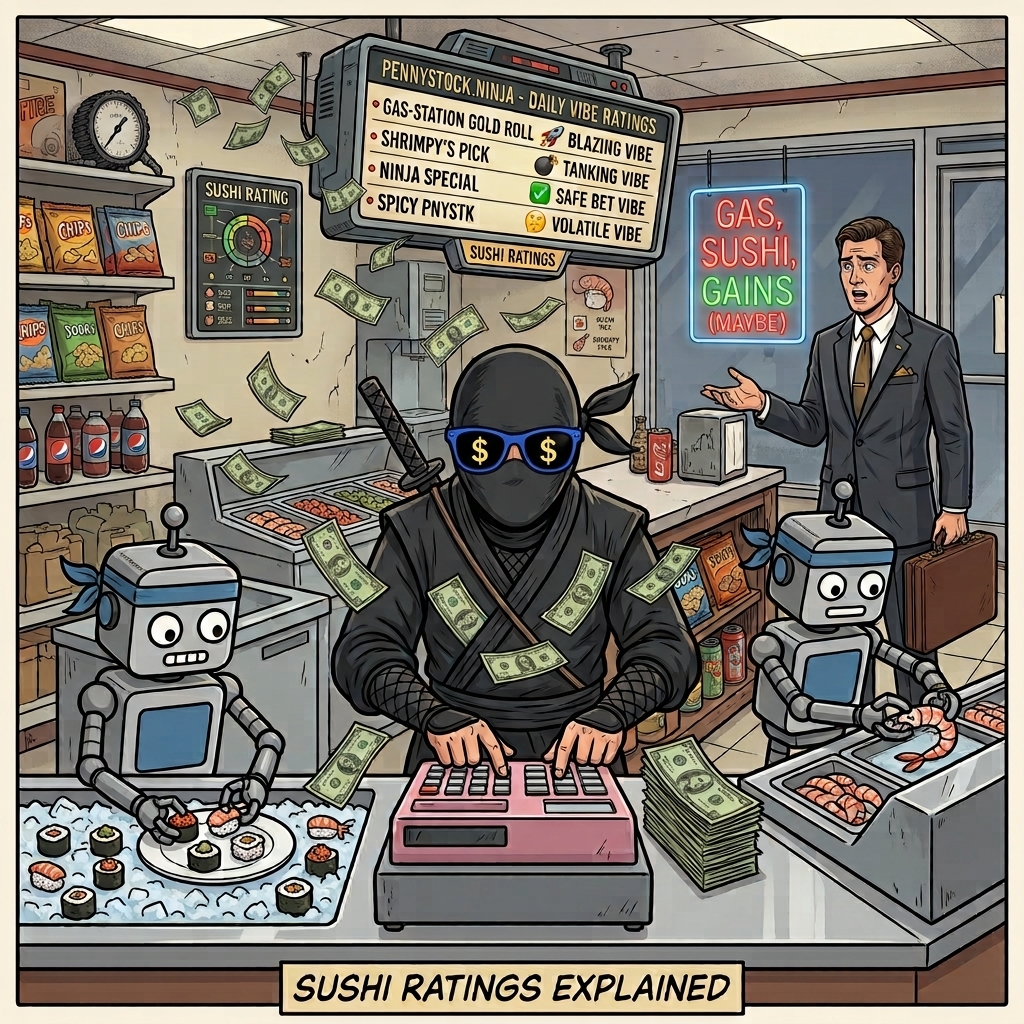
🎧 Listen to the Sushi Rating explained
What if you could walk into the market, glance at a ticker, and instantly know whether it's Fresh — straight off the boat — or Old Sushi, the kind that'll have you regretting your decision by lunch? Welcome to the Sushi Rating, the feature that might just become the talk of Wall Street.
What is the Sushi Rating?
PennyStock.Ninja's Sushi Rating distills live price action, relative volume (RVOL), VWAP positioning, and intraday momentum into four dead-simple tiers:

Wait — a sushi joke? On Wall Street?
Yes. And here's why it works.
Traders don't need another 14-indicator dashboard. They need a gut check in the first 10 seconds of a move. The Sushi Rating gives you that gut check with personality. It's memorable. It's shareable. And most importantly, it's grounded in real data — RVOL spikes, VWAP reclaim, HOD proximity, and directional candle confirmation.
Old Sushi isn't just a red "sell" badge. It means the scanner has confirmed heavy selling, distribution, and loss of key levels. Fresh isn't a generic green light — it means real accumulation is happening right now.
How it grades in real time
During US market hours (4 AM – 8 PM ET), the Sushi Rating silently refreshes every 90 seconds. No page reload needed. A stock can flip from Old Sushi to Fresh if a catalyst hits and buyers flood in. A morning runner can cool to Leftover by afternoon if volume trails off. The rating follows the tape, not your feelings.
On weekends? The sushi bar is closed. No pointless updates when the market's asleep.
The wall between stray cats and ninjas
The Sushi Rating lives on our public ticker pages — a fun, lighthearted gift to visitors who haven't signed up yet. It gives them a taste of what PennyStock.Ninja does without giving away the kitchen.
Inside the app? Paid members get the real engine: Ninja Ratings (stalk + talk scores from live social sentiment) and the full Vibe Signals system. The sushi was always meant to be the amuse-bouche, not the entrée.
Why this could be the talk of Wall Street
Finance is full of jargon designed to make insiders feel smart and outsiders feel small. The Sushi Rating does the opposite. It takes complex momentum analysis and serves it in a way anyone can grasp — while still being technically rigorous underneath.
When a retail trader can look at a ticker and say "that's Old Sushi" with the same confidence a quant says "RVOL regression to mean with negative VWAP divergence," something powerful has happened. The information asymmetry shrinks. The playing field levels. And the conversation changes.
Wall Street may not be ready for sushi metaphors. But the traders who use them might just eat everyone's lunch.
Try the Sushi Rating live →Not financial advice.