
SpaceX Isn't a Rocket Company — It's an AI + Internet Infrastructure Play
🎧 Listen to SpaceX as an AI Infrastructure Utility
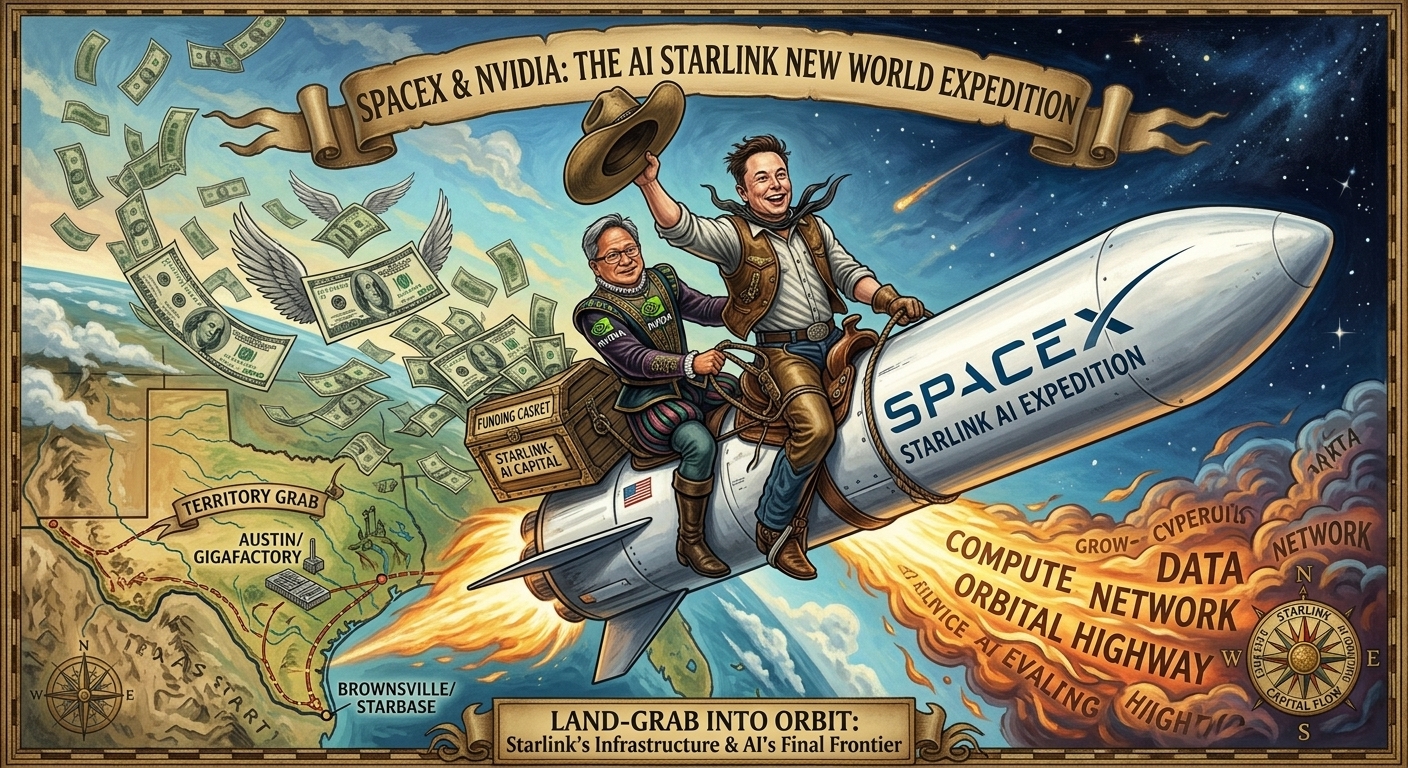
Everyone still calls Space Exploration Technologies Corp — SpaceX — a "rocket company." That framing is a decade out of date. Rockets are the delivery truck. The actual business Elon Musk is building is the physical layer of the internet and, soon, the physical layer of AI compute. And that changes what SpaceX is worth — and what retail traders should be watching on the public side.
Update: SpaceX (SPCX) recently completed its IPO and now trades publicly. Retail can finally own the parent company directly — but the sympathy basket around it (Starlink beneficiaries, launch competitors, in-space infrastructure names) is where the outsized penny-stock moves still happen. Both angles are covered below.
1. Starlink is quietly becoming the internet
Starlink now runs the largest satellite constellation ever built — thousands of low-earth-orbit birds delivering broadband to places fiber will never reach: ships, planes, farms, warzones, remote villages, RVs, and increasingly, entire cellular networks via direct-to-cell partnerships with T-Mobile and others.
The important shift: Starlink is no longer a "consumer dish" story. It's becoming wholesale internet backhaul — carriers, governments, and enterprises paying SpaceX for connectivity because the terrestrial alternatives are slower, more expensive, or don't exist. That's a utility-style revenue stream on top of a hardware moat competitors are 5+ years behind on.
2. Orbital AI compute is next
This is the part nobody's pricing in yet. Training and inference for large AI models are constrained by three things on Earth: power, cooling, and land. Space solves all three:
- Power — solar in orbit is ~10× more efficient than on the surface, and it's uninterrupted.
- Cooling — the vacuum of space is the ultimate heat sink; no water, no chillers, no permits.
- Land — orbital slots are effectively free compared to the multi-billion-dollar data center land grabs happening in Virginia and Arizona.
Starship — SpaceX's fully reusable heavy-lift vehicle — is the only launcher on the roadmap that can lift data-center-scale payloads (100+ tons per flight) at a price that makes orbital compute pencil out. Multiple startups (Starcloud, Lonestar, Axiom) are already booking Starship missions to put GPUs in orbit. SpaceX doesn't have to build the compute — it just has to own the road to get there. And it does.
3. Why this matters for a stock scanner
Now that SpaceX (SPCX) trades publicly, you can own the parent directly — but the real velocity for retail is still in the sympathy basket. Every time SpaceX ships a milestone — a Starship catch, a Starlink direct-to-cell rollout, a defense contract, an earnings print — a whole tier of public names moves with it. That's what our scanner catches.
Space-adjacent public proxies retail actually trades
- Rocket Lab (RKLB) — the closest pure-play public alternative to SpaceX. Launch + spacecraft manufacturing. Moves on every SpaceX milestone.
- AST SpaceMobile (ASTS) — direct-to-cell satellite competitor to Starlink. Trades violently on every Starlink cellular headline.
- Iridium (IRDM) — the incumbent satellite comms operator; often used as a "who gets disrupted by Starlink" pair trade.
- Planet Labs (PL) — earth-observation satellites. Rides the broader "space infrastructure" narrative.
- Intuitive Machines (LUNR) — lunar landers, NASA CLPS contracts. Moves on SpaceX/NASA news.
- Redwire (RDW) — in-space manufacturing and infrastructure components. Direct beneficiary of any "factories in orbit" narrative.
The penny-stock sympathy tier
When space is the theme of the week, the sub-$5 tape rotates through a small, familiar basket. These are the ones our scanner tends to flag:
- Sidus Space (SIDU) — small-cap satellite manufacturer, textbook sympathy runner.
- Virgin Galactic (SPCE) — no longer pure penny territory but still trades on space-sentiment.
- Satellogic warrants (SATLW) — high-beta earth-observation proxy.
- Momentus (MNTS) — in-space transportation micro-cap.
- BlackSky (BKSY) — satellite imagery, moves on defense/space contract news.
4. The bigger point
Framing SpaceX as "just rockets" is like calling Amazon in 2005 "just a bookstore." The real business is infrastructure:
- Layer 1 — Launch: Falcon 9 and Starship own low-cost access to orbit.
- Layer 2 — Connectivity: Starlink owns the last mile of internet where no wires reach.
- Layer 3 — Compute: Orbital data centers, powered by unlimited sun and cooled by vacuum, are 3–5 years out — and SpaceX owns the only affordable elevator up.
With SPCX now public, the valuation conversation stops being about rockets and starts being about a vertically integrated internet-and-compute utility with no direct competitor. Expect the tape to reprice slowly as the market figures out it's not a launch stock — it's an infrastructure stock. The public proxies (RKLB, ASTS, RDW, and the penny sympathy tier) are how retail plays the theme in between SPCX catalysts — and how our scanner catches the moves in real time.
See the live scanner →Not financial advice. Penny stocks and newly public issues are extremely volatile and can lose value rapidly.