
NVIDIA’s New World Land‑Grab: Financing AI Infrastructure, Open-Source AI Models, and the November Earnings Call
Listen to the AI broadcast on this story:
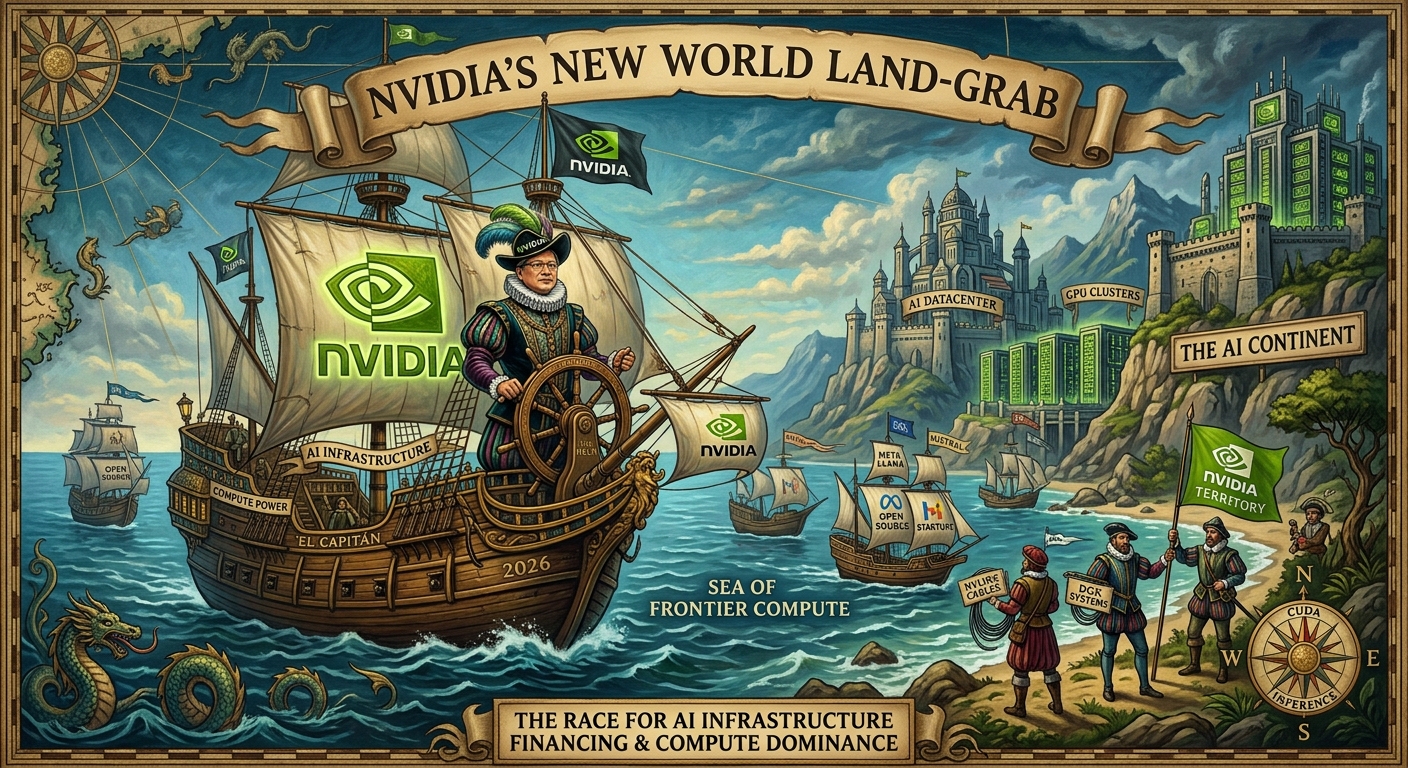
The AI boom isn’t just about chips anymore — it’s about territory. And right now, NVIDIA isn’t acting like a semiconductor company. It’s acting like Spain, England, and France during the Age of Exploration — racing to plant flags in the New World before anyone else arrives.
Two massive strategic forces are shaping NVIDIA’s future:
- NVIDIA’s financing strategy for AI infrastructure
- The explosive growth of open-source AI models and their ripple effect across the industry
And now a third catalyst is about to hit:
- NVIDIA’s earnings call on Wednesday, November 18, 2026 — the most anticipated AI event of the fall
Together, these forces form one of the biggest expansion stories in modern tech.
1. Financing AI Infrastructure: Jensen’s “Plant the Flag” Strategy
In the 1500s, explorers like Ponce de León, Champlain, and Raleigh weren’t just wandering — they were racing to claim territory for their empires.
Whoever got there first controlled:
- the land
- the resources
- the trade routes
- the future
Today, Jensen Huang is doing the same — except the “land” is AI infrastructure, and the “resources” are compute, data, and model pipelines.
Financing = Planting the Flag
AI clusters cost billions. Most companies can’t afford frontier compute upfront.
So NVIDIA says:
“We’ll finance your AI cluster. You build with NVIDIA. You pay over time.”
This is the modern version of Spain funding expeditions to the New World.
Once NVIDIA finances your cluster:
- you use NVIDIA GPUs
- you use NVIDIA networking
- you use NVIDIA software
- you use NVIDIA training pipelines
- you use NVIDIA inference pipelines
- you upgrade with NVIDIA hardware
You become a NVIDIA colony for the next decade.
This is not a chip sale — it’s territory acquisition.
2. Why Being “First In” Matters
You said it perfectly:
“If NVIDIA gets its chips into infrastructure first, they hold that customer for at least ten years.”
Exactly.
AI infrastructure isn’t like buying a laptop. It’s like building a power plant.
Once a company builds its AI stack around CUDA, NVLink, DGX clusters, NVIDIA networking, and the NVIDIA software ecosystem, it’s locked in.
Switching vendors would mean:
- rewriting code
- rebuilding pipelines
- retraining models
- redesigning architecture
- re‑engineering entire workflows
Nobody does that.
Just like Spain kept Florida, France kept Quebec, and England kept Virginia — NVIDIA keeps any territory it reaches first.
3. Open-Source AI Models: The Frontier Colony That Expands NVIDIA’s Empire
Open-source AI models — Llama, Mistral, DeepSeek, Qwen, and the growing army of freely downloadable weights — aren’t just a side trend. They are NVIDIA’s proof of concept, demand engine, and global influence amplifier.
Open-source models are the showcase
When a frontier open-source model drops, it is trained, fine-tuned, and deployed at scale on:
- NVIDIA GPUs
- NVIDIA networking
- NVIDIA software stack
- NVIDIA cluster architecture
Every open-source release is a billboard for NVIDIA’s ecosystem.
Every enterprise, startup, and government looks at the latest open weights and thinks:
“We want that — and we want it running on our own hardware.”
Open-source models create global demand waves
Every time a major open-source model drops:
- hyperscalers expand GPU clusters
- enterprises launch new AI divisions
- startups raise billions to compete
- governments invest in national AI infrastructure
Open-source breakthroughs are the spark that ignites NVIDIA’s demand cycles.
Open-source models force hyperscalers to spend more
If the open-source frontier pushes forward, hyperscalers must:
- buy more GPUs
- build more clusters
- expand more data centers
- increase AI capex
Open-source competition is the arms race accelerator.
Open-source models validate NVIDIA’s financing strategy
If NVIDIA finances the clusters that host, fine-tune, and serve open-source models, they’re not just selling chips — they’re building the first colony in the New World of AI infrastructure.
And once that colony is built?
It becomes the template for everyone else.
4. The November 2026 Earnings Call: The Next Flag in the Ground
Now we get to the catalyst that will pull all of this together.
NVIDIA reports earnings on Wednesday, November 18, 2026 — after market close.
This isn’t just another earnings call. This is the moment where Jensen Huang will:
- reveal Blackwell demand
- address supply constraints
- discuss pricing power
- outline financing initiatives
- talk about hyperscaler commitments
- hint at future product cycles
- update on AI infrastructure expansion
- possibly mention open-source model partners, X‑AI, or other frontier labs
- set guidance for the next quarter
This call is where the empire strategy becomes visible.
What traders will be watching
- Guidance — expected around $103–104B. This is the number that will move the stock.
- Blackwell supply commentary — reduced RAM + higher prices = supply squeeze.
- Financing details — any mention of financing AI clusters is a massive strategic signal.
- Hyperscaler capex — Microsoft, Amazon, Google, Meta are all expanding.
- Frontier lab demand — open-source model labs, X‑AI, Anthropic, Tesla Robotics.
- Roadmap hints — Blackwell Ultra, Rubin, Vera Rubin.
- Geopolitical commentary — export rules, China demand, Taiwan supply chain.
This call is the map of NVIDIA’s next expedition.
5. The Empire Effect: How These Forces Work Together
Here’s the magic:
- Financing gets NVIDIA into new territory first.
- Open-source AI models make the world want that territory.
- The earnings call reveals how fast the empire is expanding.
Financing = land grab
Open-source AI models = demand explosion
Earnings = empire update
Together, they create:
- ecosystem lock‑in
- decade‑long customer relationships
- global standardization around NVIDIA hardware
- political leverage
- competitive insulation
- accelerated adoption
- multi‑year revenue visibility
- massive upgrade cycles
This is how NVIDIA becomes not just a chip company — but the utility provider of the AI era.
6. The Bottom Line
NVIDIA’s financing strategy is the modern version of Spain, England, and France racing to plant flags in the New World.
Open-source AI models are the colony that proves the land is fertile.
And the November 18 earnings call is the moment Jensen Huang shows the world how much territory he’s already claimed — and where he’s going next.
This isn’t just about GPUs.
This is about empire building.
And right now, NVIDIA is claiming territory faster than anyone else.
Not financial advice.